.png)
How to Stop Beating Yourself Up Over Mistakes (From a Recovering Overthinker)

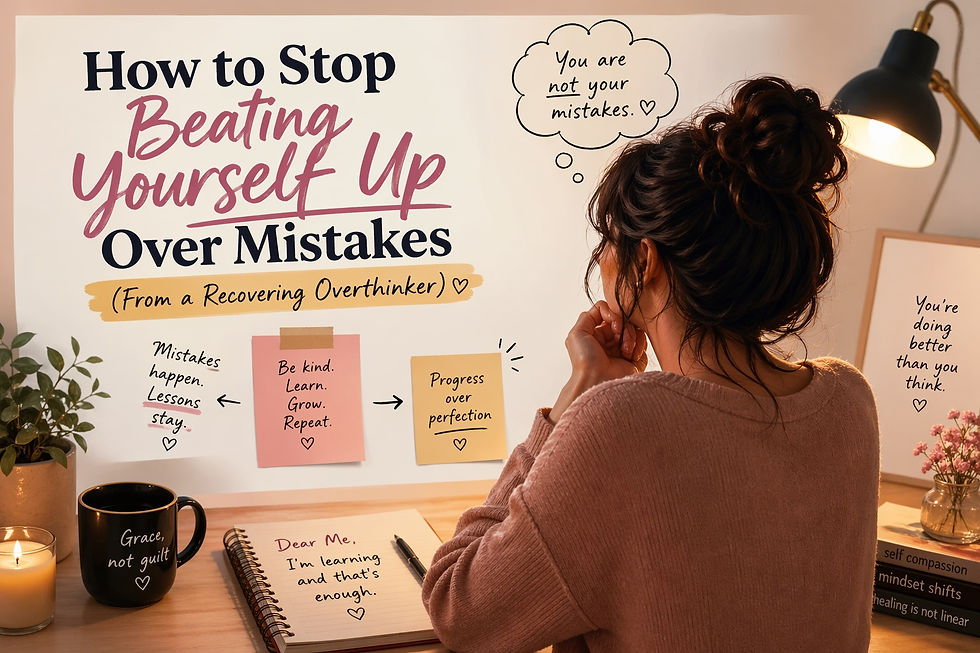
Let's start with the basics, shall we? Because before we can talk about how to stop beating yourself up over mistakes, we need to look at what a mistake actually is.
Mistake (noun): an action or judgment that is misguided or wrong. — Oxford Languages
That's it. That's all it is. An action or judgment that was misguided or wrong. It doesn't say "an action that defines your entire worth as a human being and should haunt you at 3 AM for the next fifteen years." And yet... here we are.
Hi, My Name Is Aurora and I Have a Problem With Mistakes
So let me set the scene. Imagine a support group. Folding chairs in a circle. Stale coffee. One of those motivational posters on the wall with a cat hanging from a branch that says "Hang in there."
Hi. Let me introduce myself. My name is Aurora and I'm a beat-myself-up-about-it kind of gal.
Hi, Aurora.
Thank you. It's nice to be here. I brought snacks.
Now, before you start worrying about me — I want you to know it's nowhere near as bad as it used to be. Progress has been made. Growth has occurred. But let me paint you a picture of where I started, just so you know I earn my seat in this circle.
Why Do I Overthink My Mistakes at 3 AM?
In my twenties, I would wake up in the middle of the night — not because of a noise, not because of a bad dream — but because my brain decided that 2:47 AM was the perfect time to replay something I said in middle school. Middle school! We're talking about a time when I thought butterfly clips were the pinnacle of fashion, and my brain wanted to do a full forensic analysis of a conversation I had at a locker.
"Remember that thing you said in eighth grade? Let's think about that for three hours."
Cool. Thanks, brain. Super helpful.
If you've ever found yourself overthinking past mistakes while staring at the ceiling, know that you're not broken. But it does beg the question — where does this habit come from?
Where the Fear of Making Mistakes Really Comes From
Here's the thing — and I don't think this will shock anyone who's ever sat on a therapist's couch or read literally any self-help book — the fear of making mistakes usually starts in childhood.
My family? Oh, they were the "how could you do this" kind of group. You know the type. Every mistake came with a full dramatic reenactment, a lecture series, and apparently a permanent entry into the family archive because — fun fact — they STILL bring up stuff I did or said as a kid.
I haven't been a kid for a long time, friends. A long time.
And yet at any family gathering, someone can pull out a story about little Aurora like they've been saving it in a vault. Like they rehearse it on the drive over. "Oh, you know what we should bring up at dinner? That thing from decades ago. That'll be fun."
So is it any wonder I grew up thinking that mistakes were permanent? That they followed you around like a shadow with a megaphone? If this resonates, you might want to read Childhood Trauma and Relationships: The Eight-Year-Old Who Still Lives Inside Us — because that little kid is usually the one running the shame spiral.
What Sara Blakely's Dad Taught Her About Failure
Now let me tell you about someone who had a very different dinner table experience.
Sara Blakely — yes, THE Sara Blakely, founder of Spanx, billionaire, all-around legend — grew up with a father who asked her and her brother the same question at the dinner table every night:
"What did you fail at today?"
And here's the kicker — he wasn't asking it as a gotcha. He wasn't shaking his head or pulling out a lecture. If they didn't have a failure to share? He was disappointed. Because no failure meant they hadn't tried anything new. They hadn't pushed themselves. They'd played it safe.
He was literally celebrating the mistakes.
Can you imagine? Can you imagine growing up in a house where failure meant you were brave instead of broken? Where a mistake was evidence of effort instead of evidence that you were fundamentally flawed?
I can't imagine it. But I can learn from it. And so can you. Learning from mistakes starts with changing how we frame them in the first place.
What Do YOU Do When You Make a Mistake?
So let's talk about you for a second, dear reader. When you mess up — and you will, because you're a human person living a human life — what happens next?
Option A: You beat yourself up. You replay it. You spiral. You catastrophize. You wake up at 3 AM and stare at the ceiling while your brain hosts a highlight reel of your worst moments. (Raises hand. I see you. I AM you.)
Option B: You calmly say, "What a wonderful learning opportunity," and journal about it with a cup of chamomile tea while soft music plays in the background. If this is genuinely you — wow. What an evolved soul. Truly. I aspire to be you when I grow up.
Or... liar, liar, pants on fire?
Just kidding. Really. I love you, dear reader. If you've actually achieved this level of enlightenment, please teach the rest of us. We're begging.
Option C: Some messy, beautiful, very human combination of both. You beat yourself up for a while. Then you learn the lesson. Then you beat yourself up a little more for beating yourself up. Then you learn that lesson. Rinse, repeat, grow.
Most of us live in Option C. And that's okay. If you're stuck in the perfectionism loop of Option A though, I wrote about that exact trap in Perfectionism and the Scales: When "Good Enough" Never Feels Enough — because the need to never make mistakes and the need to always be perfect? Same wound.
My Biggest Lessons Started as My Biggest Messes
Here's what I know to be true about dealing with mistakes: when I look back at the biggest learning lessons of my life — the ones that actually shaped who I am, the ones that made me smarter and stronger and more aware — they almost always started with a mistake. Sometimes a spectacular one.
Take relationships. I spent way too long in a horrific relationship. Way. Too. Long. The kind where you look back and think, "What was I doing? Who WAS that person?" But here's what that mistake gave me: it taught me to recognize red flags. Not just see them — recognize them. Feel them. Trust my gut when something was off.
And afterward? I caught them quickly. I walked away. I protected my peace.
Well... in one case, I didn't exactly walk away. I ghosted a fellow.
And listen — I don't think this blog is your cup of tea, sir, but just in case you're reading this: I'm sorry. It wasn't a mature thing to do. You deserved an actual conversation, and I gave you radio silence. That was my mistake. I own it.
(See? Growth.)
How to Redefine What a Mistake Actually Means
Let's go back to that definition:
Mistake (noun): an action or judgment that is misguided or wrong. — Oxford Languages
Now let me offer you the Karma Penguin remix:
Mistake (noun): an action or judgment that didn't go the way you planned, but — if you're paying attention — will teach you something you needed to know.
That's it. That's the reframe.
A mistake is not a life sentence. It's not a character flaw. It's not ammunition for your family to use at Thanksgiving dinner twenty years from now (although apparently nobody told my family that).
A mistake is information. It's data. It's your life saying, "Hey, not that way. Try this way instead."
How to Actually Stop Beating Yourself Up Over Mistakes
If you're a fellow member of the Beat Yourself Up About It Club, here's what I want you to know:
You're not alone. The club has millions of members. We should get jackets.
It gets better. I went from midnight panic attacks about eighth grade to writing a blog post about it with jokes. That's progress.
The goal isn't perfection. The goal is to shorten the time between the mistake and the lesson. To spend less time in the spiral and more time in the growth.
Your childhood wired you a certain way. But you're an adult now, and you get to rewire. It's hard. It's slow. It's worth it.
Sara Blakely's dad had it right. Failure means you're trying. Mistakes mean you're living. Playing it safe means you're just... existing.
And honestly? I'd rather make a spectacular mess and learn something than play it safe and learn nothing.
Self-Forgiveness After Mistakes Is the Real Flex
To my fellow 3 AM ceiling-starers, my overthinkers, my "I can't believe I said that" replayers — be gentle with yourself. You're doing better than you think. The fact that you care so much about getting it right means your heart is in the right place.
Self-forgiveness after mistakes isn't weakness. It's not letting yourself off the hook. It's acknowledging that you're a human being who is learning as you go — and that's exactly what you're supposed to be doing. If you're ready to go deeper on that, I wrote about why the old "forgive and forget" model is broken in Finding Emotional Freedom Through Forgiveness — because real forgiveness (especially self-forgiveness) looks nothing like what we were taught.
Now stop replaying that thing from 2012. It's handled. Nobody else remembers it.
Except your family. They definitely remember. They're bringing it up at Christmas.
But that's their karma, not yours. 🐧
About the Author | Day 112
I am a soul-led coach, entrepreneur, and someone who woke up at 2:47 AM this week to relitigate a conversation from seventh grade like a lawyer with no case and no client.
I work with people who replay their mistakes on a loop like a broken playlist, people who've achieved incredible things and still hear their mother's voice pointing out what they missed, and anyone who's ever apologized for something that happened so long ago that the other person doesn't even remember it — but you do, because of course you do.
I believe in the power of the reframe — not the toxic positivity kind, but the real kind, where you look at the mess and say, "Okay. What did that teach me?" I believe that Sara Blakely's dad was onto something. I believe that the family archive of your childhood mistakes doesn't define you. And I believe that the woman who ghosted a perfectly decent man and still feels guilty about it years later is proof that growth is real, even when it's messy.
One reframe, one 3 AM ceiling-stare you finally laugh about, one mistake you stop punishing yourself for at a time.


Comments