.png)
A Toxic Mother-Daughter Relationship: When She Can Hold Your Pain but Not Your Joy

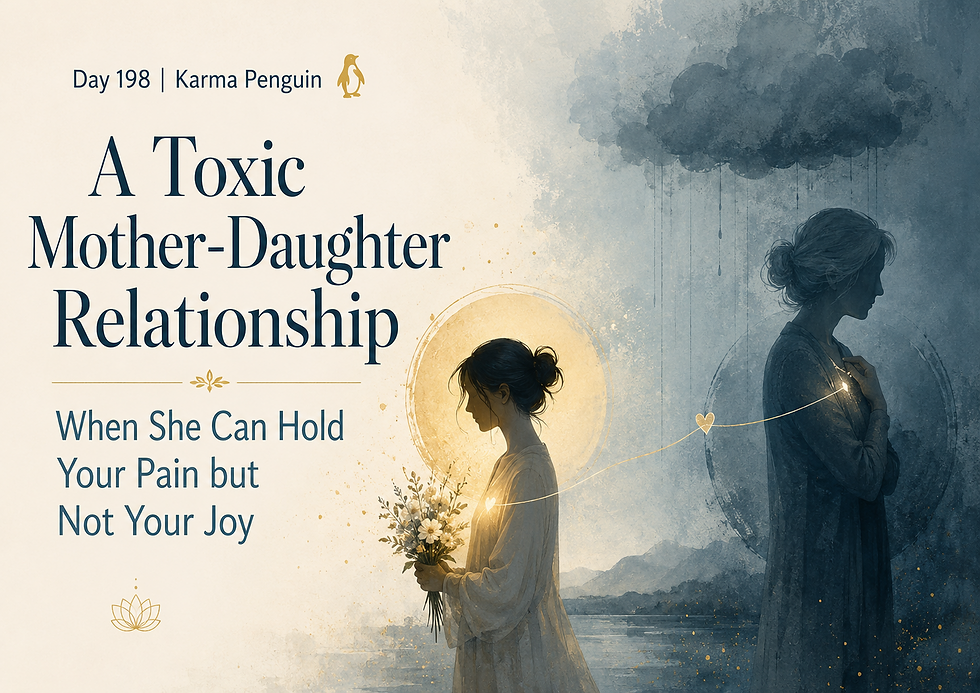
A friend wrote to me recently, and I haven't been able to shake her story.
I've changed her name and a few details to protect her privacy, but the core of what she went through is untouched. Her experience speaks to a particular kind of toxic mother-daughter relationship—one that's hard to spot precisely because the love is real. So is the support. It just tends to disappear the moment the daughter is thriving.
Let's call her Jenny.
Jenny grew up in California, and she'd be the first to tell you her childhood was hard. She worked relentlessly, made it to college on the East Coast, and eventually landed a job in London. For the first time in her life, she felt like she'd actually made it.
She had crossed an ocean, built a career, and shaped a life she used to only dream about. From the outside, it looked like everything had fallen into place.
And every time something good happened—a promotion, a new opportunity, a gorgeous apartment, a milestone in her relationship—she called her mother. Almost every time, she hung up feeling heavier than before.
For years, she couldn't figure out why.
Her mother rarely said anything you could point to as cruel. It was subtler than that. A question that planted a seed of doubt. A warning about everything that could go wrong. An abrupt change of subject. A gentle reminder not to get her hopes up.
No blowups, no obvious jabs. Nothing you could hold up as proof.
But somehow, Jenny's happiness always came out a little smaller on the other end of the call.
Then came the spiral of second-guessing.
Did I sound like I was bragging? Am I being too sensitive? Am I asking for too much?
Maybe she should share less. Maybe it was safer to stay quiet about the parts of her life that were going right.
Here's the strange part, though: when things fell apart, her mother showed up.
When Jenny was heartbroken, scared, disappointed, or unsure of herself, her mother turned warm and steady. She listened. She comforted. She made Jenny feel held.
It took years for the pattern to come into focus.
Her mother knew exactly how to hold her pain. She just didn't seem to know what to do with her joy.
Recognizing a Toxic Mother-Daughter Relationship
Eventually, Jenny started to see what was underneath those conversations.
Her mother had married young and let go of any real chance at a career of her own. Jenny knew it had been her mother's choice, but she also sensed a quiet grief attached to it—grief that had never been named, let alone faced.
Sometimes it felt like her mother wanted Jenny to make the very same choices. Not out of any wish to see her unhappy. Jenny came to wonder if her independence forced her mother to confront the life she might have had.
Every promotion, every opportunity, every adventure seemed to spotlight the road her mother never walked.
Jenny couldn't know for sure what her mother felt or what fueled her reactions. But she started to suspect that shrinking Jenny's success made her mother's own sacrifices a little easier to carry.
Maybe if Jenny had married young, stayed close, and set aside some of her ambitions too, her mother wouldn't have to look quite so hard at her own decisions.
The realization didn't leave Jenny angry. Mostly, it left her sad.
She loved her mother. She understood how much her mother had struggled and given up. She could see how unresolved regret might leak into the way a person responds to someone else's freedom.
But understanding where the behavior came from didn't make it hurt any less.
For years, Jenny had mistaken comfort in hard times for genuine emotional safety. Because her mother showed up when she was hurting, Jenny assumed the heaviness she felt after sharing good news must have been her own doing.
It wasn't.
Some people are most at ease when we need them. They know what to do with our pain—they can advise, reassure, rescue, or slip into a familiar role.
Our happiness asks something different of them.
Our growth can remind them of what they left behind. Our independence can make them feel less needed. Our success can force them to face dreams they buried a long time ago.
That doesn't always mean they consciously want us to fail. Sometimes it just means their own unhealed grief makes it hard to celebrate us without dragging fear, regret, or resentment into the moment.
One of the hardest parts of Jenny's healing was accepting that her mother might never become the person she wanted to call first with good news.
She had to grieve the relationship she kept hoping they'd someday have. And she had to stop bringing her joy to a place where it kept curdling into guilt, anxiety, or self-doubt.
That didn't mean she had to stop loving her mother. It didn't mean cutting her off or casting her as the villain. It meant getting more protective of the parts of herself that were still taking root.
So Jenny started sharing good news first with people who could celebrate it without immediately hunting for the catch. She stopped defending every decision. She began paying attention to how her body felt after a conversation. She learned that not everyone earns access to a dream while it's still fragile.
And most importantly, she stopped waiting for anyone else's approval before letting herself feel proud.
Jenny found she could hold compassion for the life her mother gave up without surrendering the life she'd worked so hard to build.
Maybe that's the lesson buried in her story.
You aren't disloyal for noticing which relationships make your joy feel unsafe. You aren't selfish for wanting the people you love to celebrate you. And you don't have to turn someone into a monster to admit they may not be a safe place for every part of you.
Some people can hold your pain but not your joy.
Once you see that pattern clearly, the answer isn't always to walk away. Sometimes it's simply to stop handing someone the parts of you they've already shown you they can't hold.
About the Author | Day 198
I'm a soul-led coach, writer, entrepreneur, mother, and recovering perfectionist. I believe healing often begins the moment we finally name the patterns we've spent years explaining away.
For 198 days, I've shown up in this space to write about the things we tend to hide—the grief tucked beneath success, the weight of complicated relationships, the fear of disappointing the people we love, and the quiet courage it takes to choose a different road.
Karma Penguin is a place for honest healing—no shame, no blame, no spiritual bypassing. I write for people learning to trust what they feel, protect what's still tender, and stop shrinking their joy just to keep someone else comfortable.
Day 198 is a reminder that compassion and boundaries can live side by side. We can understand someone's wounds without letting those wounds decide the life we're meant to live.



Comments